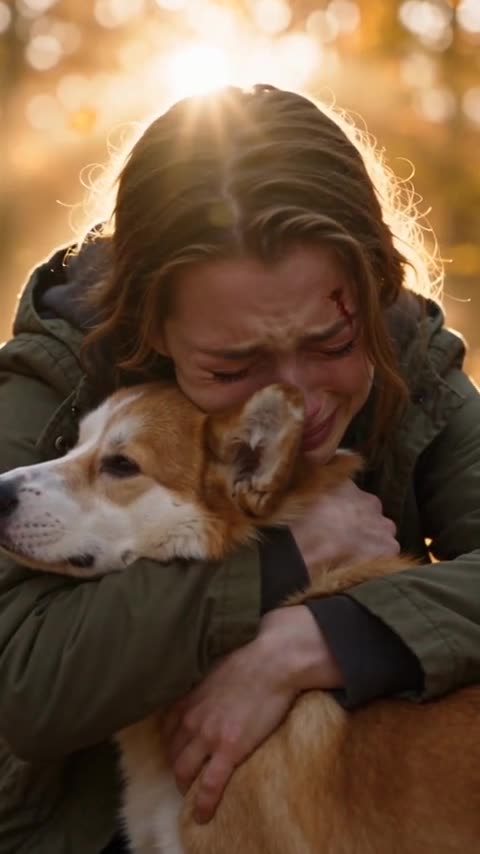
Why the pet version works
The pet version uses the same reversal as the couple story, but the relationship is different. A dog or cat cannot explain what happened; the survivor has to recognise them from a collar, a tag, a marking or the way they move. That makes the recognition beat quieter and often harder to watch.
The story is still a love story. The pet turns, the survivor cannot shoot, the gun lowers, and the scene cuts to a warm memory of the two of you together. The horror is the setup; the hug is the point.
The recognition moment
Give the model one detail it can carry from the cold half to the memory. A collar tag is the clearest. A distinctive patch of fur, one ear that sits differently, or a familiar harness also works.
If the pet has no collar, use the fur pattern. A black cat or a dark dog against a dark background is harder; choose a photo with enough contrast to see the face and the markings. The model keeps the fur colours and markings as far as the render allows, but it does not promise an exact breed match.
The survivor should be at the pet's height in the emotional beat. A person standing over a small animal reads as a threat; kneeling or crouching reads as an offer. The pet version often works best when the gun lowers early and the survivor kneels before the animal comes to them.
Dog and cat photos
Dogs
- Use a front-facing photo with both eyes visible and the mouth closed or relaxed.
- A plain background helps the model separate the dog from the room.
- Keep the collar and tag visible if they are part of the recognition.
- A half-body photo is better than a tiny full-body shot; the face needs detail.
Cats
- Choose a photo where the cat is facing the camera, not turning away.
- Avoid a black cat on a black sofa if you can; the fur detail disappears.
- Keep both ears and both eyes in frame.
- A calm, alert expression reads better than a blurry action shot.
For both, use the original photo. A heavy beauty filter on a pet is rare, but a strong colour filter or a heavy vignette can still hide the markings.
Story ideas for pets
| Idea | Cast | Recognition detail |
|---|---|---|
| The walk in the woods | You and your dog | A collar tag or a favourite harness |
| The kitchen morning | You and your cat | A distinctive patch of fur |
| The first night home | You and a rescue pet | The blanket or toy from the first night |
| The beach trip | You and your dog | A bandana or a wet-fur pattern |
| The window seat | You and your cat | The same window and the same light |
These are generic setups. Use only a pet you own or have the owner's permission to feature.
What to avoid
- A dark pet on a dark background. The fur detail disappears; use a lighter background or a photo with more contrast.
- A tiny face in a full-body shot. Crop closer so the eyes and markings are readable.
- An action shot. A pet mid-jump or mid-run is harder than a calm, front-facing photo.
- No recognisable detail. A collar, tag, harness or distinctive marking gives the memory a thread.
- A heavy colour filter. It can hide the fur pattern the model needs.
If the pet is very dark, take the photo in daylight against a lighter wall or a window. If the pet will not sit still, a treat held just above the camera often gets a clear, front-facing frame.
The pet example
The sample on this page is a real render from this pipeline: one photo of a person and one of a pet, turned into a 15-second story. It shows the cold present, the recognition and the warm memory. It is an example of the format, not a customer testimonial, and a new render will not match it frame for frame.
Settings and format
9:16 is the natural choice for a phone feed and keeps the person and the pet close in the frame. 16:9 gives the room or the field more space, which can help a larger dog or a wide memory shot.
All three scene settings work for pets. A Snowed-In Cabin or a Ruined Chapel gives the cold half a clear contrast with a warm outdoor memory; Rain-Soaked City works if you want a street story. The setting changes the room, not the relationship.
Ready to make one? The pet zombie video generator starts with the pet story already selected — upload one photo of you and one of your pet.
FAQ
Can I do the zombie trend with my dog or cat?
Yes. Use one photo of you and one of your pet. The pet becomes the infected lover, and a collar, tag or fur marking is the recognition moment.
Will my pet still look like my pet?
The model keeps the face, fur colours and markings as far as the render allows. A sharp, front-facing photo gives it the best chance. It is a generated take, not a cutout of the original photo.
Is the zombie pet scary or gory?
The visual language is pale skin or a dull coat, clouded eyes and dark veins. The story avoids a gunshot and graphic gore. The focus is the recognition and the hug.
Does it work with other animals?
The product is designed for dogs and cats. Another animal may work if the photo is clear and the face is readable, but the story and the recognition details are tuned for a pet you know.
How long does a pet video take?
Usually 2–6 minutes. The render continues if you close the page; the video appears in My videos when it is ready.